Introduction
Earlier this year, the Government of the United Kingdom published its national security assessment titled “Global biodiversity loss, ecosystem collapse and national security”. This crucial document can be seen as a shift in the current approach to biodiversity loss and research towards framing it as a national security concern. This article will take a closer look at what reframing biodiversity as “security” can mean.
Before exploring these links in more detail, it is useful to clarify what we mean by “security” and “resilience”. Security is often understood as protection from threats that can undermine the stability and well-being of societies, including risks to food systems, public health, economies, infrastructure, and geopolitical stability. Resilience refers to the capacity of communities, economies, and ecosystems to withstand shocks, adapt to changing conditions, and recover from disruptions.
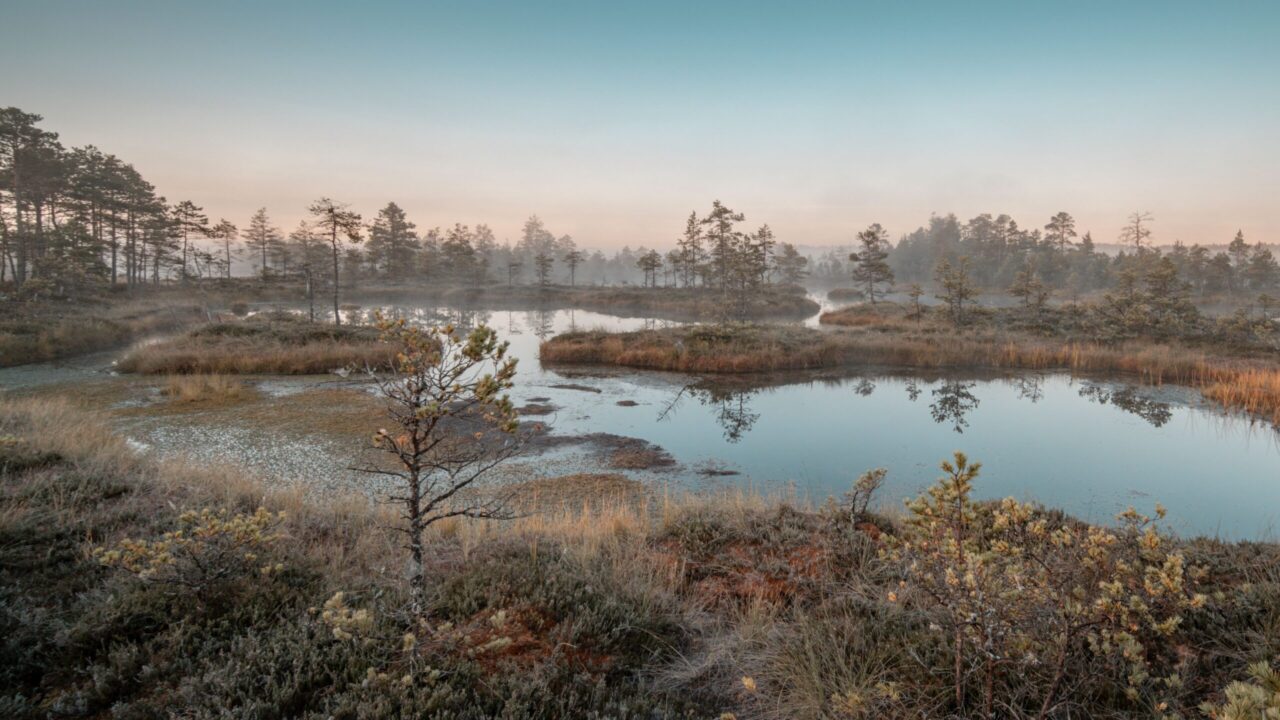
In recent years, there has been a rise in research on how biodiversity can enhance security. One example of this is bogs. Bogs (peatland ecosystems) are critical biodiversity hotspots for many countries, including some EU Member States, e.g. Poland, Finland, and Sweden. Not only are they essential habitats for unique fauna and flora, but they can also serve as defensive shields: in the past, many bogs were dried on purpose to provide more space for agriculture, but some were kept to form part of territories’ external defence lines. Today, some countries are reconsidering bog restoration, with one of the incentives being their effective defensive capabilities.
This is one example of how healthy ecosystems contribute to national security, and how biodiversity needs to be protected, or restored where needed, in order to safeguard it. Conversely, the UK assessment highlights the negative impact of biodiversity loss and ecosystem collapse, and how this can hugely endanger our security.
The impact of biodiversity loss on national security
So, now we know our national security can benefit from biodiversity, but the inverse question also requires our attention. What happens to our national security in the face of large-scale biodiversity loss? For this, we look again at the recently released report by the UK national government. The report highlights nine key areas where biodiversity loss negatively impacts national security. We have chosen four of these that we think are particularly relevant today.
- Migration
- Migration is an issue that has been at the centre of almost every political discussion in recent election cycles across Europe. While at the moment the majority of irregular migrants are asylum seekers from conflict regions, as the impacts of climate change and biodiversity loss continue to intensify, environmentally mediated irregular migration could potentially increase. Weaker or even collapsing food systems, as a result of the loss of pollination services, have the potential to exacerbate preexisting pressures on local livelihoods. This highlights the interconnectedness of environmental degradation with other drivers of outmigration. And as the report states, “A one percentage increase in food insecurity in a population compels 1.9 per cent more people to migrate”.
- Pandemic risk
- One of the main drivers of biodiversity loss is human encroachment into natural areas. As species lose their natural habitats, the likelihood that they come in contact with humans increases, along with the potential for zoonotic disease transmission. Coupled with global human movements, whether regular or irregular, the chances of a COVID-19 level global pandemic massively increase. With the loss of biodiversity, we also lose potential opportunities for discovering novel treatments for such outbreaks, or other medical applications.
- Economic insecurity
- As highlighted by the latest European Environment Report by the EEA, 72% of companies in the EU depend on at least one ecosystem service, generating 234 billion euros worth of value in 2019 alone. Therefore, any significant loss in biodiversity directly impacts European economic security and competitiveness. From our forestry sector, agricultural sector, to the drinking water sector, wherever you look, there are major economic pillars that rely on services provided by a healthy ecosystem.
- Geopolitical competition
- The global competition for scarce resources is of particular relevance when it comes to water resources. A prime example of this is the conflict between India and Pakistan over the Indus River. This article is too short to dive into the complexities of this conflict; nevertheless, it is important to note that climate-induced water scarcity in this region is amplifying already existing geopolitical tensions between these countries. Conflicts between countries for limited resources are by no means limited to water. Minerals, arable land and safe transit routes are all potential areas for conflict.
Framing biodiversity
We hope that the interlinkages between biodiversity loss and national security are starting to become clearer. But, how is this reflected in EU countries’ national security strategies, if at all? This is an important step because the framing of a problem determines how you approach potential solutions and, importantly, if and how you convince the public to care about it.
Across the national security strategies we analysed, the main frame used to relate biodiversity loss to security involves climate change. Unlike the British report, other countries do not treat biodiversity loss as a main threat, but merely an amplified effect of global climate change. Biodiversity protection or restoration is thus not seen as the main solution in many strategies. Unsurprisingly, this framing reflects current political situations. Take Germany as an example: under the government of Chancellor Olaf Scholz, biodiversity loss was mentioned 11 times in the national security strategy and is recognised as a national and international threat. Fast forward a couple of years, and now, under the new government, biodiversity is framed as a potential nuisance in carrying out military activity.
Why should it matter to YOUth?
For youth, framing of biodiversity loss as a security threat should be seen as a crucial turning point. Not only is it a call for further protection of ecosystems, it is also a warning sign that nature restoration is increasingly necessary. The UK assessment also draws on some of the frontline thresholds for Earth’s critical tipping points, such as the Amazon Rainforest, coral reefs and mangroves in South East Asia, the boreal forest in Canada, and more. Some of these ecosystems could face collapse as early as 2030–2050. Our collective future safety and security, therefore, faces higher levels of uncertainty. This is a clear warning sign and a call to action: as the negative impact on biodiversity increases, so will the resulting security issues, if no action is taken. But is it already too late to act?
As mentioned in the introduction, biodiversity, security and resilience are interlinked. Researchers see that further protection, restoration and support for biodiversity can only strengthen our safety, both in the areas mentioned by the UK assessment and in military security (as in the example of bogs). Further investments in nature can only improve safety across the whole EU. However, there is a serious gap in biodiversity funding in the European Union. Increasing awareness and participation among young people in local biodiversity and conservation activities is a way to strengthen public support for nature protection and efforts to combat biodiversity loss. This ultimately benefits YOUth by helping to secure the healthy ecosystems on which our future well-being, resilience, and security depend. It’s your time to act!
Conclusions
Governments need to see biodiversity loss not only as an environmental issue but also as a direct threat to national security. The example of Germany shows how important this shift in framing is, as it actually changes how societies prioritise the issue. In practice, it can mean that presenting biodiversity loss as a threat to economic stability, food security, migration, or geopolitical stability may encourage governments to act more decisively than using a purely environmental narrative. It’s about recognising that stable ecosystems are fundamental to stable and secure societies. And, as highlighted by the UK assessment, the time to act is now. The path towards resilience and stability of our societies must include preventing further biodiversity loss and working for its restoration, as a necessary part of achieving long-term security.
Unfortunately, as seen in the EEA 2025 Europe’s environment main report, the state of Europe′s biodiversity seems to be deteriorating. This is why the European Nature Restoration Regulation is crucial. EU Member States must submit Nature Restoration Plans to the European Commission by September 2026. This is your chance to get involved in your country’s consultation process, local biodiversity and conservation-related activities or even in your own biodiversity advocacy. There is no time to waste; we have to protect our biodiversity in order to safeguard our security.
For more information on how to get involved in your country’s Nature Restoration Plan, check out our toolkit.